The Bottom of the Escalator
First published in Father Stories, published by Beyond Words, Feb. 2026
My father met me at the bottom of the escalator at Logan, as he had done dozens of times, always in the same spot with the same expression.
He looked like a retired fisherman waiting at the sea’s edge after the latest hurricane, reining in his excitement that his son returned at all. My father didn’t tell us he loved us, but his face always betrayed him. It was the same grin I saw as I walked onstage in a tuxedo to play “The Entertainer” at the third-grade talent show—the one he wore again when Danny Jr. shook George W.’s hand at the Naval Academy commencement.
I grabbed the heavy winter coat he had draped over one arm. Once I had it on, he handed me a styrofoam Dunkie’s cup. He pointed at the navy duffel over my shoulder. “Want me to take that?” I looked down at my father. Nearly a foot shorter than me, he moved slower each time I reached the bottom of the escalator.
“I’ve got it, Dad.”
“You made good time.” He would have been up at 4:30 a.m. checking my flight details before scrolling through the weather forecast for the four places his children lived, in case one of us happened to call and ask if we should wear a sweater.
We grabbed my bags from a slow-moving carousel. I’d managed to pack everything I had left into two large suitcases. A weekend of purging led me to give up the skinny clothes I’d been holding on to. Extra-tall Ralph Lauren polos in twenty-two distinct colors were going to delight some other gay giant browsing at the charity shop.
Dad struggled to remember if he’d parked on the Faneuil Hall or U.S.S. Constitution level of the parking garage. He began reprimanding the automated teller who asked him to insert his ticket in the opposite direction. I grabbed it from him to save us all some time.
“You used to be able to talk to an actual person,” he said. “All these computers and not a one of them knows what the hell’s going on.”
“All right, Dad. Okay,” I said, already sliding into my latent Boston accent. I handed the machine the last of my cash and resolved the matter in two button punches.
The wind whipped through the garage, flash-freezing every crevice I’d left uncovered. My outstretched ears and cheeks were fair game, but it even chilled the gaps where my jeans failed to overlap my ankle socks and the inch of belly overhanging my belt. I packed my suitcases into the back of his Suburban and hopped into the passenger seat.
We took Dad’s shortcut through Southie. It took at least fifteen minutes longer than staying on the Pike, but it enabled him to point out the boarding house where his grandparents lived for their first twenty married years. He asked if I’d heard this story before and didn’t blink an eye when I told him I’d heard it at least a thousand times. Away he went—Nana crossing the mighty ocean with nothing but the clothes on her back and the address of a distant relation in Boston sewn into the hem of her dress. Did I know they had saved for years and could only send one child over? Nana scrimped and saved to bring the others, but then her first child came, and then the second, and soon she had eleven mouths to feed herself. The story always ended the same way: “she never saw them again” and a wistful stare at a red light. And then, unsatisfied with one downbeat when two were available, Dad reminded me that Nana held me, I wasn’t even three days old, the week before she died, her eyes white with cataracts, blind as a bat she was, how she’d wept when she heard I’d bear the name of her baby brother.
“Thought we’d get some breakfast,” Dad said, as if it were a surprise that we’d head to the same place we did after every red-eye I’d ever taken.
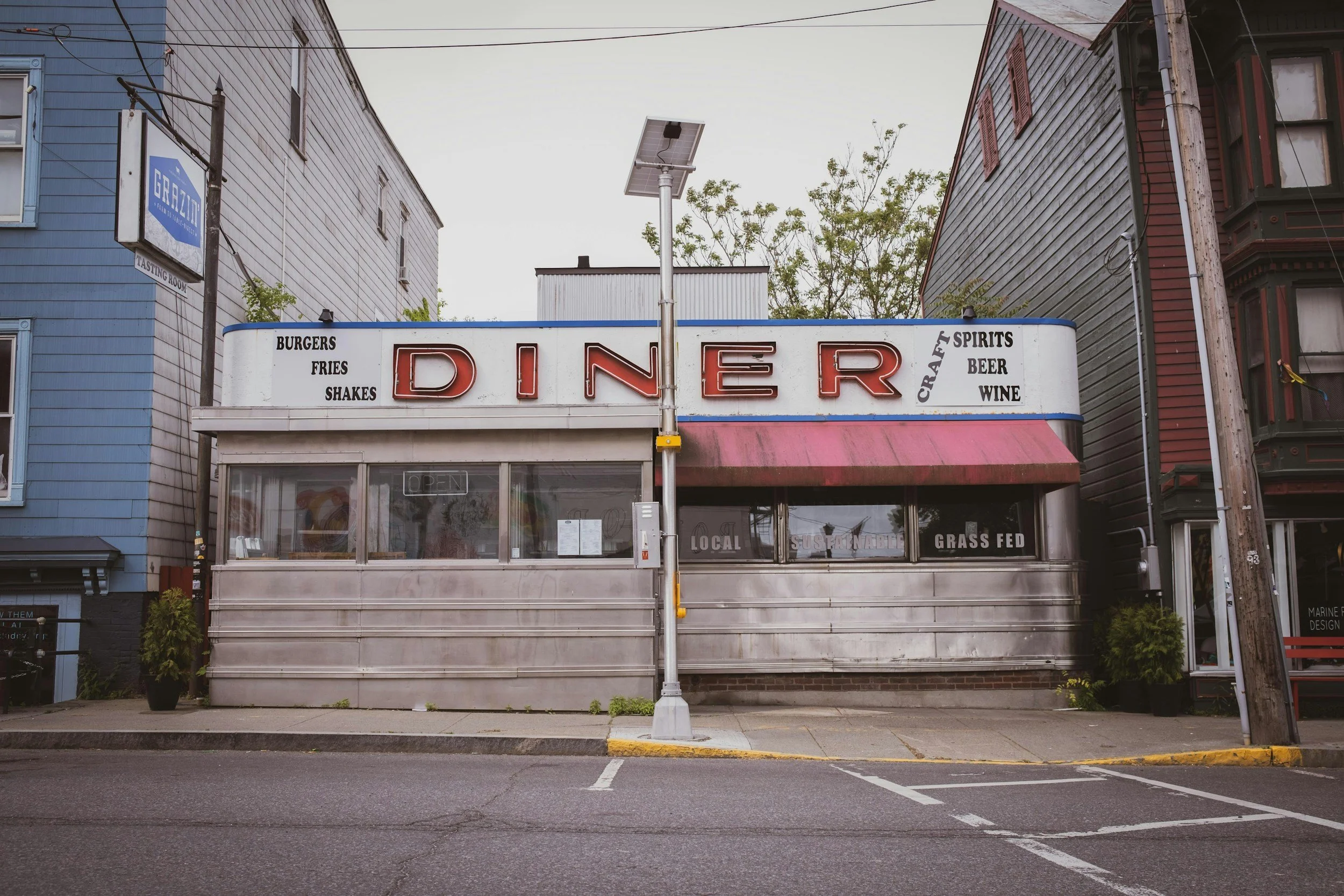
Mul’s Diner in Southie had been serving breakfast to union workers since 1947 and to my Dad and me since I left for college. A metallic rectangle, its waitresses seemed to have a fifteen-second limit on interactions that they kept according to an internalized clock. The walls were covered booth to ceiling in sports memorabilia. The Globe cover after the 2004 Red Sox victory was in the center with an overhead light fixture assuring it would glow eternally.
I ordered some hodgepodge of fried meats, eggs, and potatoes that might make up for the fact I hadn’t slept in twenty hours. Dad ordered the blueberry pancakes, making the usual comment that they wouldn’t be as good as the ones he made at the cabin in Maine. We settled into our comfortable routine. I listed off my high school friends’ current professions, romantic entanglements, and offspring. He noted which restaurants we once ate at had gone out of business, which busy streets might get goddamned bike lanes, which old friends and relatives were still alive and which were dead. Dad didn’t mention his recent skin cancer diagnosis that Mary Pat discovered for us when trying to organize his bills. He didn’t tell me about his law firm dissolving, the increasing frequency of Ma’s ice clinking, the tub they had to replace with a walk-in shower after multiple falls. I did not say a word about my debilitating debt, the unsuccessful job interviews (fourteen and counting), or the hole cratering at my center that grew wider each day despite my efforts to fill it with sex and the sauce. From my father, I inherited an ability to talk all day without ever saying a thing.
The middle-aged waitress dumped our meals in front of us. She used her spare thirteen seconds to corner a cop she clearly wanted to bang, wedding ring on his pudgy finger be damned. We ate in silence for a while until Dad turned his eyes upward to Larry Bird and said, “I’m sorry about you and François.”
It was the first and last time I remember hearing my Dad speak that name. I had never come out to my father directly. The coward in me had won out when I’d told my mother I was seeing François and asked her to relay the news to him. “Your father and I both love you very much” had been the emailed response, entirely in the subject line with a blank message underneath. I’d been relieved never to have to bring up the topic with my father who reveled in my creative accomplishments yet wondered how in god’s name I batted a consistent .000 during my one season of Little League.
“It’s okay,” I replied, turning my attention to the suddenly phallic sausage in front of me. I covered it with some eggs.
Dad scraped the butter off the top of his pancakes. “I know it’s not what you might’ve had in mind, but I called your cousin, Kevin.”
“Oh, yeah?”
“He can get you a job down the tolls. It might get you back on your feet until you can find something better.”
“They still have toll booths here?”
The Commonwealth had a way of resisting modernity. Its liquor stores were closed on Sundays until only a decade prior, and happy hours were still banned. Some days it felt like the Puritans were still running things.
Dad blew on his coffee. “They’re still there. Haven’t gotten rid of our Kevin yet. Something you should consider.”
I championed the working class as a liberal cause, but I thought that my college degree and decade of corporate drudgery entitled me to avoid blue-collar jobs for life. I sipped my coffee and thought of Nana collecting the week’s pay in cash every Friday before Pa Fitz could hand it over to the bartender at Armrhein’s. She’d split it into envelopes hidden around the house: rent, electricity, maybe a few pennies toward new shoes for one of the kids. How she’d sacrificed for her son to get through high school and become a policeman, the fifty-one weeks a year he’d worked until he dropped dead at fifty-two, so he could send his son to college to become a lawyer, all those drunk drivers Dad had grudgingly kept out of jail so that I could go to drama school and become a toll collector on the Massachusetts Turnpike.
“How much does it pay?” I asked, grabbing the last insulin pen I had and injecting what I could spare.
“You’d start around forty-five grand,” Dad said. “But with all the overtime, you could get up near ninety. I know it’s not a San Francisco-type salary, but it’s got good insurance, and you could save a little until you find the right thing.”
I certainly could. My parents were going to charge me twelve hundred a month, so carry the one, minus the gin, this should work out in my favor, and I’d be back in the Bay in no time.
He waved his fork in the air. “And who knows, you might make a play out of it.”
“The tolls it is, I guess.”
“And never mind that,” he said, referencing my dour expression. “It’s just for the time being. Someone will snap you up quick. They’d be lucky to have you.”
Was that about the job or François?
Another waitress who must have been pushing eighty came over to refill our coffee cups. “Now, Danny, which one is this?”
“This is Sean, the theatre director.”
“Your dad’s told me all about you,” she said. “You’re the one in London?”
“Yes,” I said. “I was, yes.”
“He’s told me all about your plays and what a big success you are over there. Across the pond? Is that what they say?”
“That’s what they say.”
She totaled our bill. “How long you in town for?”
“Indefinitely, I guess.”
“Good for you. Your parents will be so happy to have you home.” She ripped our check off the pad and tossed it on the table face-down. “Good luck with everything. Don’t forget us when you get to Hollywood.”
Dad paid cash and left a solid tip. After I got my coat on, he put his hand on my shoulder.
“It’s raining in London anyway, pal.”